Controlled Visual Systems
created using a template for creating digital exhibits
Contents: About the Collection | About the About Page | Tech
About the Collection
This project constructs a visual and conceptual history of the controlled visual system: a framework in which images are generated through the interaction of constraint and variation, producing seemingly endless permutations within a bounded structure.
Across science, mathematics, philosophy, and art, this system appears in different forms—fractal geometry, stochastic processes, perceptual theory, and iterative artistic practice—each proposing that repetition does not produce sameness, but difference.
The work draws on the philosophical investigations of Ludwig Wittgenstein, particularly his understanding of perception as structured by systems of relations rather than fixed meanings, alongside Gilles Deleuze, whose concept of repetition as a generator of difference provides a model for thinking variation as a productive force rather than deviation.
In parallel, the project situates itself within a lineage of artistic practices that operate through controlled systems: from the gestural fields of Jackson Pollock—where chance is mediated by bodily constraint—to instruction-based and generative frameworks in conceptual art, and later critiques of institutional display systems such as the “white cube.”
Rather than treating the digital as a break from these histories, this collection positions it as a continuation: a space in which systems of repetition, sampling, and iteration become explicit, programmable, and infinitely extensible.
This site is generated using CB-GH CollectionBuilder-GH, a project to create a free and simple digital collection using GitHub Pages from:
- a CSV of collection metadata
- To use the Github web interface
Collection History
The included works—photograms, iterative digital sculptures, and installation views—function as both artworks and models. Each operates as a closed system defined by specific constraints (frame size, sampling field, spatial placement), yet produces a potentially infinite series of variations through the controlled interaction of light, material, and algorithmic process. In this sense, the collection is not only an archive but an active system: a visualization of how images are generated, repeated, and transformed across contexts—from analog light exposure to digital sampling—while remaining structurally bound to the rules that produce them.
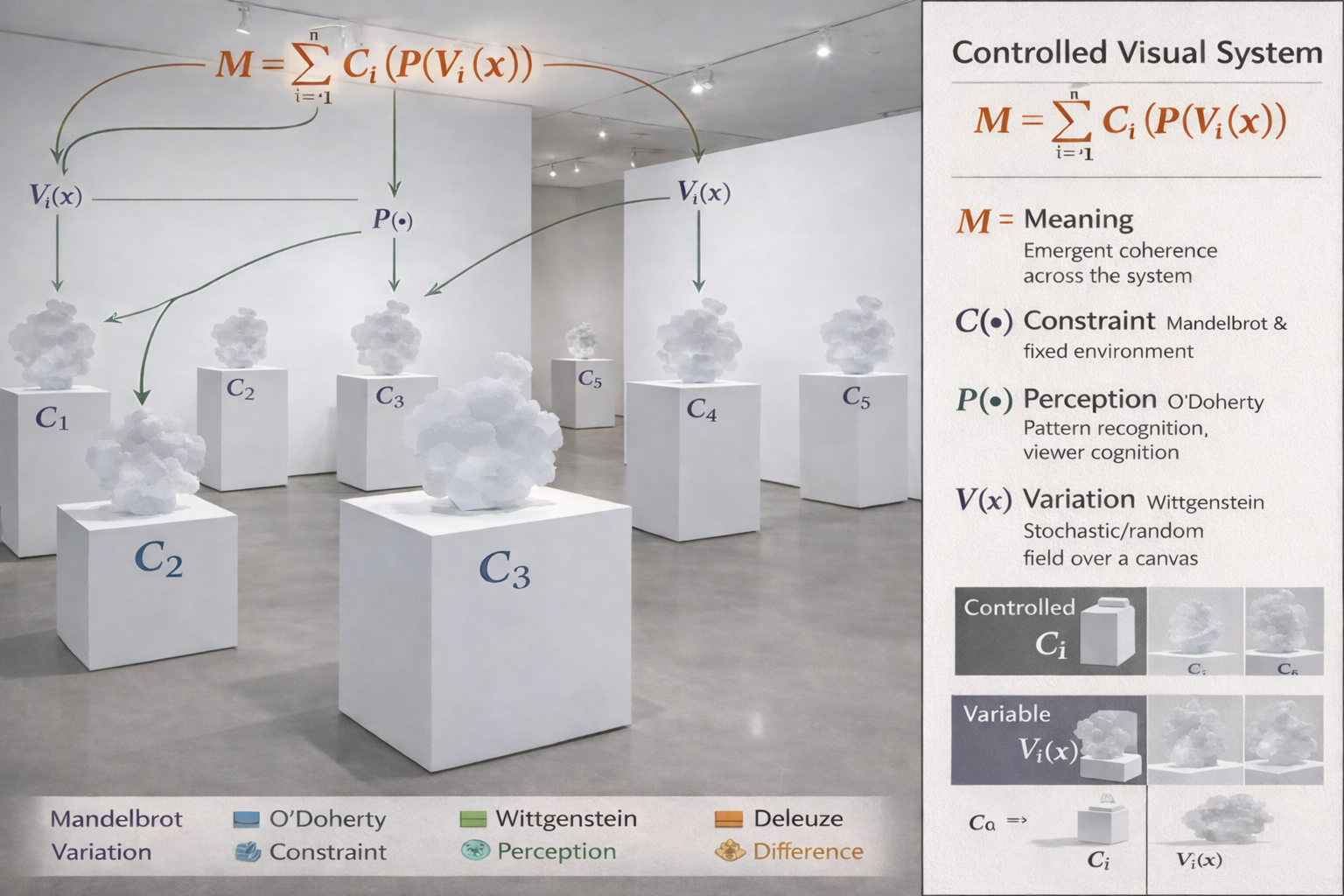
System Components =
(1)Photograms: Light-based systems where variation emerges through exposure within fixed film frames.; (2)Iterative Sculptures: Digitally generated forms using sampling (stamp tool) as a mechanism of repetition and difference.; and (3)Installations: Spatial systems in which repetition across objects produces a perceptual field.
View the collection
The card features an image from the collection
Technical Credits - CollectionBuilder
This digital collection is built with CollectionBuilder, an open source framework for creating digital collection and exhibit websites that is developed by faculty librarians at the University of Idaho Library following the Lib-Static methodology.
Using the CollectionBuilder-CSV template and the static website generator Jekyll, this project creates an engaging interface to explore driven by metadata.